

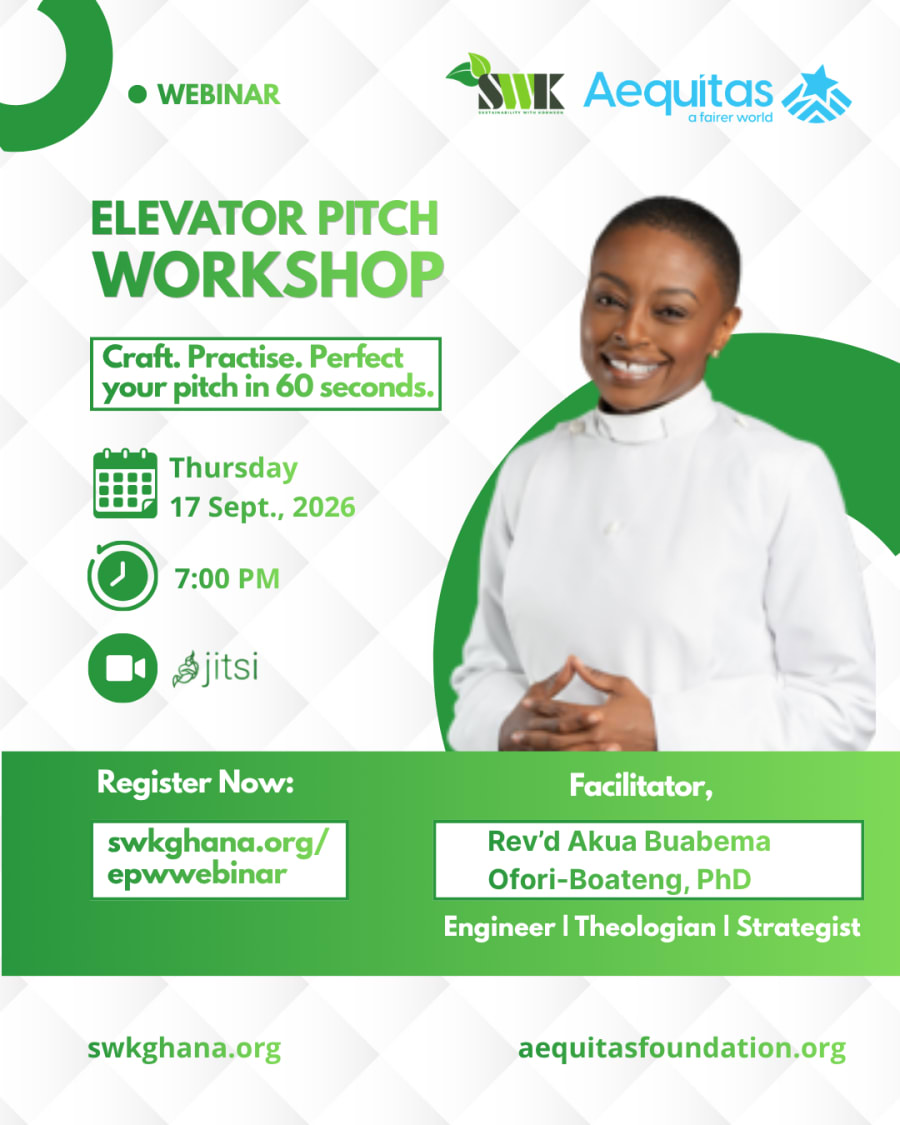
Workshop highlights
30+ joined us live to craft, practise and perfect their pitch.
Rev’d Akua Buabema Ofori-Boateng, PhD, taught a six-part, 60-second pitch and built in two rounds of practice; Ben Brown moderated for SWK Ghana. Some participants dropped out because of network problems and technical issues with Jitsi, so our report sets out what we will do differently next time.

Why this matters
The idea is not the hard part. Being understood is.
Africa has the highest rate of entrepreneurship in the world, and more than three-quarters of African youth plan to start a business within five years. Yet capital and networks stay stubbornly out of reach — not always for want of a good idea, but for want of a clear one.
Investors lean on credentialed trust, using elite education and global networks as shorthand for lower risk. That creates a two-speed ecosystem. One practical lever closes part of that gap: the ability to explain what you do, clearly and credibly, in the time it takes to ride an elevator.
The research is blunt about it. Pitch quality measurably shifts investment decisions — and not only the content, but the delivery: tone, expression, word choice. This workshop treated the pitch as a skill you practise, not a talent you either have or lack.
The framework
Six parts. Sixty seconds.
The heart of Rev’d Akua’s session was the anatomy of a great pitch: six parts, each with a rough time budget, so the whole thing fits in a minute.
-
8 sec
Hook
Win attention with your very first line.
-
7 sec
Who you are
Your name and role, kept brief.
-
10 sec
The problem
The gap or need you address.
-
15 sec
Your solution
What you do about it.
-
10 sec
The value
Why it matters, or a quick proof point.
-
10 sec
The ask
The one thing you would like to happen next.
About 150 words, spoken naturally, fills a minute. Time yourself out loud until the rhythm feels familiar, not memorised.
The 90 minutes
From framework to practice.
The session was built as a workshop, not a lecture: the framework first, then two rounds of writing, pitching and feedback.
Why the elevator pitch matters
What a pitch is and where it earns its keep: networking events, job interviews, funding and partnership talks, and every “so what do you do?”. Clarity builds trust, a steady pitch shows you know your value, and brevity respects the listener’s time.
Anatomy of a great pitch
The six parts above, piece by piece, and how to time them.
Mistakes to avoid, hooks that land
Five common mistakes, from jargon to having no clear ask; four ways to open (a question, a bold statement, a surprising insight or a short story); a fill-in-the-blank template; and example pitches, including an agri-tech founder linking smallholder farmers with buyers.
Exercise 1: craft your pitch
One honest sentence for each part of the template: who you help, what you help them do, the benefit, how you differ from the alternative, and a call to action. No polishing yet.
Exercise 2: pair up & present
One partner pitches while the other keeps time, then shares one thing that landed and one thing to sharpen, using a five-point check: clarity, hook, structure, confidence and call to action. Then swap.
Delivery tips & round two
Practise out loud, look at your listener or the camera, pause after your hook, match your energy to your message, and smile. Then rewrite the pitch with the feedback and deliver it to a new partner: confident and clear, not perfect.
Takeaways, next steps & Q&A
Clear beats clever. One idea, not everything. Always end with an ask. Practice makes it sound natural. Then a week of daily practice, and the pitch tried on three people.
Who it’s for
Anyone who has to make someone care, fast.
Registration was open to everyone. You did not need a company, a product, or a funding round to get something out of it.
- Entrepreneurs and startup founders at any stage
- Agribusiness operators and food system changemakers
- Community leaders and social enterprise practitioners
- Students and recent graduates exploring entrepreneurship
- NGO and civil society professionals seeking funding or partners
- Professionals in career transitions
- Youth leaders and fellowship alumni
- Anyone tired of fumbling “so, what do you do?”
Facilitator
Rev’d Akua Buabema Ofori-Boateng, PhD
Anglican Priest · Engineer · Theologian · Strategist
Rev’d Dr Akua Ofori-Boateng is a priest, engineer and strategist, currently Director of Programmes for the Anglican Diocese of Accra. Her career spans twenty years in the corporate sector — from engineering research in the United States to executive management in Ghana’s energy sector — and she brings that pragmatic, solution-oriented lens to her ministry.
Her academic path runs from Physics and Mechanical Engineering through Business Administration to a PhD in Theology. She serves as a Commissioner on Ghana’s Electoral Commission and a Board Member of the Otumfuo Osei Tutu II Foundation, and ministers as an Associate Minister with the Tema Joint Church.
She is the founding Executive Director of Aequitas Foundation, our partner for this workshop.
linktr.ee/revakuaPartner and takeaways
What participants took away
- A six-part structure for a 60-second pitch, with a time budget for each part
- A fill-in-the-blank template to draft any pitch from
- Four ways to open a pitch, and five mistakes to avoid
- A five-point check for giving and getting feedback
- A plan for the week after: practise daily, out loud, and try the pitch on three people
- An onward route into the SWK Agribusiness Fellowship and the 2026 Summit
Our partner: Aequitas Foundation
Aequitas Foundation is a faith-based nonprofit in Accra working towards a fairer world — aequitas is Latin for equity. It puts that into practice through youth development and skills-building, most visibly through the Aequitas Experience, which equips young people with the professional, interpersonal and leadership skills the modern workplace actually asks for, in partnership with organisations including Absa Bank Ghana.
aequitasfoundation.orgThat’s a wrap.
The Elevator Pitch Workshop took place on Thursday 17 September 2026. Thank you to everyone who joined and practised with us. Our next event is the Agribusiness Summit 2026 — free and in person, Saturday 7 November in Accra.
Missed part of it? Read the event report. Want to hear about the next workshop? Join our WhatsApp community.
More from SWK Ghana
This is one of several.
Agribusiness Summit 2026
Our first in-person flagship event. A free, half-day summit in Accra on 7 November: a keynote, a rapid-fire panel, a hands-on Agribusiness Model Canvas workshop, live demonstrations, and a youth pitch showcase.
Explore the Summit Support the SummitCall for Volunteers
Support registration, logistics, media and content, or documentation at the Agribusiness Summit. Apply for the role that matches your skills.
Apply to volunteer Support the SummitCall for Partners
Sponsor, contribute in-kind, or lend expertise to help create an experience that leaves young people Inspired, Equipped & Connected.
Become a partner The organisationswkghana.org
Everything else we do: youth development, circular economy, agribusiness, technology, climate action and community engagement.
Visit the main website